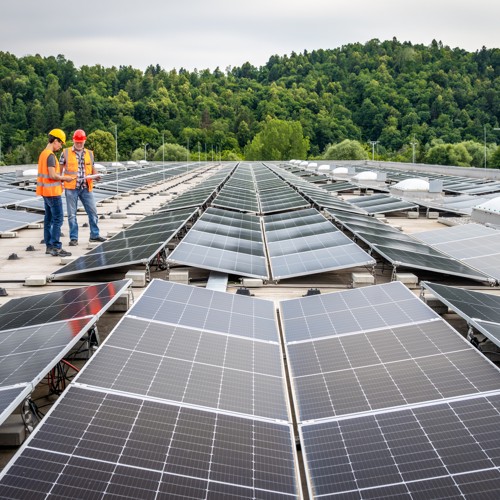
Tomislav Bunjevac at the Solar Flex Energy Conference
Flexibility and Energy Storage
Date publishedMarch 18, 2026
Zagreb, 18 March 2026 – Tomislav Bunjevac, Managing Director of ENNA Next, participated in the Solar Flex Croatia 2026 conference. The event took place in Zagreb on Tuesday, 17 March 2026, and was organised by Renewable Energy Sources Croatia and SolarPower Europe. Discussions focused on the role of flexibility and energy storage in the continued development of the power system.
Tomislav Bunjevac took part in a panel discussion on demand-side flexibility at the level of households and small and medium-sized enterprises. Other panellists included Ivan Burul, Advisor to the Management Board of HEP-ODS; Žarko Latković, Head of the Energy Efficiency and Renewable Energy Department at the Environmental Protection and Energy Efficiency Fund; Anto Matijašević, Head of Product Management at Energy3000; and Dino Mileta, Managing Director of Uprise.
Bunjevac presented ENNA Next as an aggregator, explaining that this development was a natural progression, given that the company is an electricity and natural gas supplier, a purchaser of renewable energy, and also designs and delivers photovoltaic power plants and battery storage systems for both business customers and households.
“We provide aFRR and mFRR balancing services. Our portfolio includes around 50 assets across various technologies; on the generation side, this includes biogas plants, biomass facilities, wind farms and solar power plants. Our customers are predominantly industrial, spanning a range of sectors, and we typically deliver tailored solutions. Our engineers assess each industrial customer’s potential to provide ancillary services and determine whether they are capable of delivering aFRR, where the response is automatic and must occur within five minutes, or only mFRR, which is activated manually with a response time of 12.5 minutes. In addition, our portfolio includes several battery systems co-located with solar power plants, which we also manage and use to provide ancillary services,” said Bunjevac.
When it comes to battery systems, he emphasised that each customer is approached individually to determine the required power and storage capacity, depending on the installed capacity of the solar power plant and the consumption profile.
“We configure systems using our own tools and run time-based simulations to determine the optimal solution for each end customer. This is our core know-how and the greatest value we can offer, as we are closely engaged with the market and monitor production and consumption profiles on a daily basis. We leverage this expertise to provide both customers and producers with optimal solutions in terms of battery sizing,” Bunjevac added.
In addition to business customers, ENNA Next also offers battery systems to households, where interest continues to grow.
“We prepared early for the transition to the new billing model and the phase-out of net metering, and we offer our customers integrated photovoltaic and battery solutions. We expect this segment to gradually develop, alongside increasing public awareness—particularly as household electricity consumption rises and the number of electric vehicles on the market continues to grow,” Bunjevac said.
Žarko Latković, Head of the Energy Efficiency and Renewable Energy Department at the Environmental Protection and Energy Efficiency Fund, announced that subsidies for the installation of solar power systems and battery storage will again be available this year. A total of €20 million has been secured through the Competitiveness and Cohesion Programme—€10 million allocated for heat pumps and photovoltaic systems, and €10 million for battery storage systems. Applications for battery installation will be open both to households that already have solar systems installed and to those planning to install them.

In the central part of the Solar Flex conference, the study “Identification of Grid Congestion Locations in the Power System and the Need for Battery Energy Storage in the Republic of Croatia” was presented by Ninoslav Holjevac, PhD (FER), and Dražen Balić, PhD (EIHP).
The study provides, for the first time, a systematic identification of constraints within the transmission network, while also defining optimal locations and required capacities for battery storage systems. It demonstrates that, without the parallel development of both the grid and battery storage, Croatia will not be able to integrate further growth in renewable energy sources.
The analysis shows that, under current conditions, 22 priority locations have been identified with a total potential of up to 1,700 MW. By comparison, the NECP (Integrated National Energy and Climate Plan) scenario projects approximately 350 MW by 2030. In a full renewable energy integration scenario, the requirement increases to more than 1,600 MW, with the highest concentration in Dalmatia and the Rijeka region.
News
#NextMore news >
Tomislav Bunjevac at the Solar Flex Energy Conference
Energy Sector Trends: Battery Storage Systems as a Key Element of Flexibility
Install a battery storage system with the support of non-repayable grants

ENNA Next at the "Renewable Energy" conference in Romania